Showing posts with label Gyp the Blood. Show all posts
Showing posts with label Gyp the Blood. Show all posts
Collective bargaining, what’s that?? Before last week, the only kinds of unions that showed up in the news were civil unions. Now, with the governor of Wisconsin calling for the end of collective bargaining for public employees of the state, signaling a move on the right towards targeting labor rights in general, unions are big news. While Democrat state senators have fled the state to avoid the quorum that Governor Scott Walker needs to pass his anti-union bill, President Obama has spoken out against the bill. Meanwhile, the Tea Party has arrived to counter the protest at Madison’s state capital building, and to up the crazy quotient in Wisconsin in general, which is usually pretty high anyways. I mean, these are people that walk around wearing cheese on their heads at all times, apparently.

We at Bareknuckle Vengeance feel the need to throw in our collective voice to this terribly complex situation. Here’s what we have to say:
1. The right to bargain collectively is a pretty good one.
2. We don’t know Walker personally, but we think he seems like kind of a dick.
Now that that’s clear, I suggest that we all watch some good pro-union films. Here are three of my favorites. Let me know of others that I missed.
Harlan County, USA
This film from the early 1970s won the Academy Award for best documentary, and its easy to see why; the filmmaker captures the entire year long strike at a Kentucky coal mine, chronicling the nasty tactics of the mining corporation and its local allies and the tremendous efforts of the miners. My favorite scene is one which a miner travels to New York City and ends up talking to a policeman on the street. The miner is shocked when the policeman tells him how great his pay and benefits are. (In Wisconsin of course, the policemen's union is safe from Walker’s plan since it endorsed him the last election. Methinks that we're not ready for democracy yet.)
 Cradle Will Rock
Tim Robbin’s masterfully written, star studded recreation of the eponymous Great Depression era agitprop play. Marc Blitzstein’s 1937 socialist musical, the first of its kind, tells the story of steel workers in Steeltown, USA who organize after World War I. Robbins weaves Blitzstein’s story in with those of Diego Rivera, Nelson Rockefeller, and Federal Theater Project director Hallie Flanagan, whose autobiography and HUAC transcripts provided much of the film’s dialog. And did I mention it has Bill Murray, Hank Azaria, Jack Black, John Cusack, Joan Cusack, Vanessa Redgrave, Cary Elwes, and John Turturro?
Matewan
One of John Sayles’ best films, and that’s saying quite a bit. Matewan depicts the “coal wars” of the 1920s in West Virginia, and he does so with a keen eye towards not only the murderous tactics of the coal company, but also by shedding light on the ways in which matters of race intersected the battle between capital and labor. The company brings in black and Italian workers via railroad, hoping to appeal to the xenophobia and bigotry of the local miners. I guess its unlikely that we will see the kind of violence depicted in Matewan show up in Madison, and thats definitely a good thing. But understanding the country's past labor battles, even if we do so through good film, might help put the right's new attacks on unions in some sort of perspective.
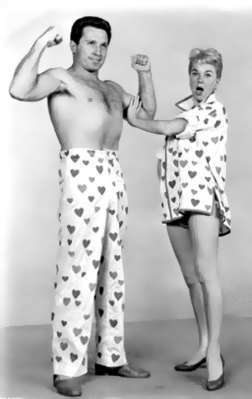
 Finally, whatever you do, don’t see Pajama Game, the 1957 Doris Day musical romantic comedy about women who strike at a pajama factory. It really sucks.

We at Bareknuckle Vengeance feel the need to throw in our collective voice to this terribly complex situation. Here’s what we have to say:
1. The right to bargain collectively is a pretty good one.
2. We don’t know Walker personally, but we think he seems like kind of a dick.
Now that that’s clear, I suggest that we all watch some good pro-union films. Here are three of my favorites. Let me know of others that I missed.
Harlan County, USA
This film from the early 1970s won the Academy Award for best documentary, and its easy to see why; the filmmaker captures the entire year long strike at a Kentucky coal mine, chronicling the nasty tactics of the mining corporation and its local allies and the tremendous efforts of the miners. My favorite scene is one which a miner travels to New York City and ends up talking to a policeman on the street. The miner is shocked when the policeman tells him how great his pay and benefits are. (In Wisconsin of course, the policemen's union is safe from Walker’s plan since it endorsed him the last election. Methinks that we're not ready for democracy yet.)
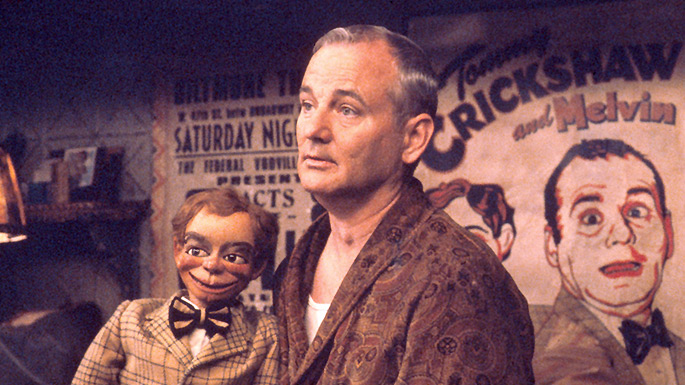
Tim Robbin’s masterfully written, star studded recreation of the eponymous Great Depression era agitprop play. Marc Blitzstein’s 1937 socialist musical, the first of its kind, tells the story of steel workers in Steeltown, USA who organize after World War I. Robbins weaves Blitzstein’s story in with those of Diego Rivera, Nelson Rockefeller, and Federal Theater Project director Hallie Flanagan, whose autobiography and HUAC transcripts provided much of the film’s dialog. And did I mention it has Bill Murray, Hank Azaria, Jack Black, John Cusack, Joan Cusack, Vanessa Redgrave, Cary Elwes, and John Turturro?
Matewan
One of John Sayles’ best films, and that’s saying quite a bit. Matewan depicts the “coal wars” of the 1920s in West Virginia, and he does so with a keen eye towards not only the murderous tactics of the coal company, but also by shedding light on the ways in which matters of race intersected the battle between capital and labor. The company brings in black and Italian workers via railroad, hoping to appeal to the xenophobia and bigotry of the local miners. I guess its unlikely that we will see the kind of violence depicted in Matewan show up in Madison, and thats definitely a good thing. But understanding the country's past labor battles, even if we do so through good film, might help put the right's new attacks on unions in some sort of perspective.
Nope, this is not an argument for the arming of Tucson citizens with Batarangs.
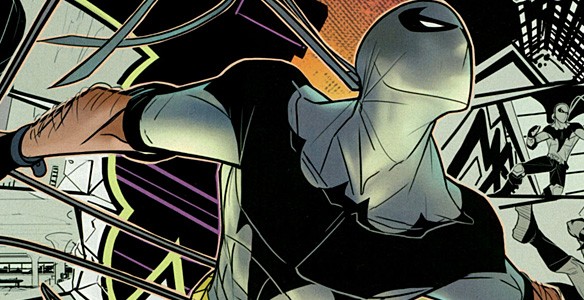
There was a minor eruption in the blogospere recently over a decision by DC Comics to create a spin-off of Batman, to market in France, which would feature a “Muslim Batman.” The storyline goes something like this: Bruce Wayne has decided to franchise his brand around the world, leading to the creation of Batman, Inc. While in France, he finds Bilal Asselah, who is arrested after being caught up in the 2005 immigrant riots while dressed up in spandex and running up walls, and Wayne picks Asselah to be Paris’s coolest new superhero, Nightrunner.

People were upset. Al Arabiyah reports that the outrage within France has been minimal, but blogs around the world are condemning the decision to make France’s Batman a Muslim. Immigrants, you see, “have been rampaging across the country for several years now,” according to one blogger. The “Angy White Dude Blog” was confounded by the idea that a Batman character would ascribe to the “religion of murder.” But the argument that appears to have resonated the most is simply that France should have a French Batman. And apparently, Bilal Asselah isn’t French. Except he was born there.
“Apparently Batman couldn't find any actual Frenchman [sic] to be the ‘French savior,’” complained one blogger. The issue is not simply one of religion, although certainly attitudes towards Islam play a major factor in the blacklash against a Muslim Batman. More acutely, French people (and apparently white people everywhere), don’t want France to be understood as a Maghrebi or non-white nation. There is a fear that the nation that created its national identity, according to Jules Michelet, around the superhero Joan of Arc is at risk of losing that identity to a more popular superhero. Everyone loves Batman, so with the creation of a “French” version, the stakes of identity are high.
 |
| Whose Paris? |
So why are rabid right-wing Americans so concerned with Frenchness? One hears echoes of the birther movement -- even though Barack Obama was born in the United States, his most extremist critics push his perceived foreigness. Maybe they’re concerned about their own othered region to the South -- Mexico. The day of the shooting of Gabrielle Giffords, the New York Times published a story about the abolition of ethnic studies programs in Arizona public schools. (It didn’t get much attention due to the events in Tucson that day.) Because Tucson teacher Curtis Acosta’s class taught students to understood the history of United States imperialism and to explore the contingencies of state borders and national identities, it was understood to be sowing the seeds of division and hatred. Arizona likes its history like the French right likes its Batman: nativistic.
The opposition to the Muslim Batman probably won’t amount to much, but it did lead the creator of Nightrunner, David Hine, to respond to his critics. When asked what he thought about the charge that Bilal is not a Frenchman, he responded: “I’d like to see [the bloggers] in a room full of French Algerians making that point.” But when pressed, he stepped back from the controversy, insisting that he wasn’t trying to make a political statement, only trying to write good comics.
Comics, of course, have always been political, ever since DC published the first Superman story in which the hero battled evil bankers. The early Superman comics were heavy with New Deal politics. Deeper readings would reveal that Superman himself was an immigrant, an intent often ascribed to his creators’ foreignness. Jerry Siegel and Joe Shuster were Jewish immigrants at the head of a long line of Jewish immigrant and first generation American comic book writers, including Will Eisner, Harvey Kurtzman, Jack Kirby and Stan Lee. Their creations, like X-Men, Mad Magazine, and even Captain America, have often questioned or satirized nationalistic or bigoted discourses. But explicit critiques of normative Americanness were off-limits, the writers’ own subjectivities bound by a heavily assimilationist culture.
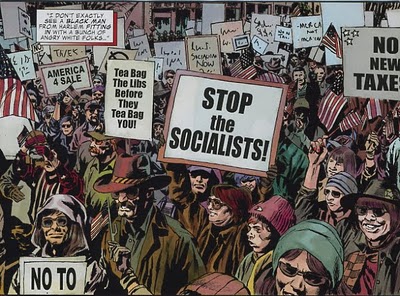 |
| Captain America took on these Tea-Partiers last year. |
So, in imposing strict anti-immigration policies, abolishing ethnic studies, arming white citizens, and deporting anyone who looks funny, Arizona is doing something far worse than creating an atmosphere of fear and hatred, and threatening thousands of people’s material well beings. The state is quite possibly preventing the appearance of the next Harvey Pekar (who passed away recently). And that is unacceptable.

Let’s hope that a Nightrunner movie gets made someday, to show popular audiences the vision of demotic cosmopolitanism that the Jewish-American comic writers fell short of. If all goes well, M. Night Shyamalan will direct, and will cast Jim Carrey in the role of Bilal.
You can find more Nightrunner artwork here: http://trevormc112.deviantart.com/gallery/?offset=0
Film critics get paid a lot of money to see a lot of movies. One recent year, Peter Travers, movie critic for Rolling Stone, wrote that he watched more than 400 theatrical releases in 365 days. (He gave four stars to all of them, undoubtedly.) Here at Bareknuckle Vengeance, we’re too busy fighting the man to watch every movie that comes out. I haven’t seen Biutiful, or 127 Hours, or the King’s Speech, so I hesitate to make a “Best of” or “Top Ten” list. And I’m not going to waste the space here talking about how great the Social Network or Black Swan is, although I liked them both a lot, because you’re more likely to have seen them. But here are a few movies you might have missed:
El Secreto de Sus Ojos - This Argentinian film won the best Foreign Language Academy Award last year, but it was only distributed in the U.S. in 2010. It tells the story of an investigator who failed to crack a murder case and revisits it decades later, along with a relationship with his superior that fizzled out along with the case. You don’t need to know anything about Argentinian politics to enjoy the snaking storyline or the questions that the film raises about memory and trauma, and you won’t come away learning much about Argentina either. But El Secreto de Sus Ojos satisfyingly works on two levels; the decisions and attitudes of the film’s various characters are stand-ins for the varying stances on “truth and reconciliation” that wrenchingly played out on a national level after Argentina emerged from a dirty war prosecuted against its own people by the ruling military junta.
Machete - This movie should never have worked. But it does, incredibly. Modeled after the same Grindhouse pulp movies as was Robert Rodriguez’s prior film Planet Terror, Machete succeeds where that one failed chiefly because of its more straight-forward plot and likeable characters. It wears its politics on its sleeve, but perhaps its didactism is tempered by the sheer awesome ridiculousness of its violence. Who would have thought that a movie with so many has-been actors crammed in to the supporting cast -- including Cheech Marin, Don Johnson, Steven Seagal, Lindsay Lohan, Jeff Fahey and <cough cough> Robert DeNiro <cough cough> -- would have turned out so well?
Mother - The latest from Korean filmmaker Bong Joon-Ho, I think the less that I say about Mother’s plot the better. The film is at its heart about the unswerving loyalty of a mother towards her son, but twists in the story beg questions of the audience about how we understand the borders between right and wrong, hero and criminal, victim and victimizer. All of the characters have complex motivations, and none find solutions to the problems in their lives that don’t affect those around them. Like El Secreto de Sus Ojos, I believe this is actually a 2009 film that was released in the states in 2010. If you have Netflix, you can stream the movie now.
El Secreto de Sus Ojos - This Argentinian film won the best Foreign Language Academy Award last year, but it was only distributed in the U.S. in 2010. It tells the story of an investigator who failed to crack a murder case and revisits it decades later, along with a relationship with his superior that fizzled out along with the case. You don’t need to know anything about Argentinian politics to enjoy the snaking storyline or the questions that the film raises about memory and trauma, and you won’t come away learning much about Argentina either. But El Secreto de Sus Ojos satisfyingly works on two levels; the decisions and attitudes of the film’s various characters are stand-ins for the varying stances on “truth and reconciliation” that wrenchingly played out on a national level after Argentina emerged from a dirty war prosecuted against its own people by the ruling military junta.
Machete - This movie should never have worked. But it does, incredibly. Modeled after the same Grindhouse pulp movies as was Robert Rodriguez’s prior film Planet Terror, Machete succeeds where that one failed chiefly because of its more straight-forward plot and likeable characters. It wears its politics on its sleeve, but perhaps its didactism is tempered by the sheer awesome ridiculousness of its violence. Who would have thought that a movie with so many has-been actors crammed in to the supporting cast -- including Cheech Marin, Don Johnson, Steven Seagal, Lindsay Lohan, Jeff Fahey and <cough cough> Robert DeNiro <cough cough> -- would have turned out so well?
Mother - The latest from Korean filmmaker Bong Joon-Ho, I think the less that I say about Mother’s plot the better. The film is at its heart about the unswerving loyalty of a mother towards her son, but twists in the story beg questions of the audience about how we understand the borders between right and wrong, hero and criminal, victim and victimizer. All of the characters have complex motivations, and none find solutions to the problems in their lives that don’t affect those around them. Like El Secreto de Sus Ojos, I believe this is actually a 2009 film that was released in the states in 2010. If you have Netflix, you can stream the movie now.
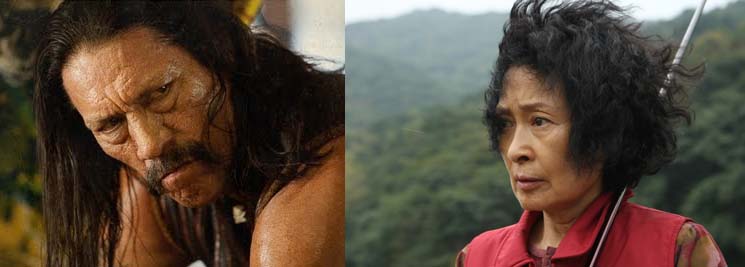
Machete vs. Mother: It would be a close fight.
Exit Through the Gift Shop - I’m still not sure if this is a fake documentary about a real artist, or a real documentary about a fake artist. But either way, I think the point of the film, which follows an amateur L.A. videographer turned street artist turned local art celebrity, is that there is no way to characterize art as “real” or “fake” anyways, that authenticity in modern art is constructed, and in turn, commodified. In that way, the film is similar to another documentary about art, My Kid Could Paint That. But whereas in that movie, the filmmakers studiously try to redraw the lines between fake and authentic even as they begin to crumble around their protagonist, Exit Through the Gift Shop is more carefree, letting the artists, whoever the hell they really are, have the last laugh.
The Kids Are Alright - Conservative L.A. Times columnist Jonah Goldberg recently celebrated the rise of the homosexual bourgeoisie as a sign of the decline of more radical leftist movements, and I think he would find much to like about The Kids Are Alright as emblematic of the phenomenon as he understands it. I guess that I too wrote about this, albeit from a more critical and speculative perspective, but I still like The Kids Are Alright, a movie about a lesbian couple with teenage children. Even if they all live in a magical crunchy granola bohemia-land, the characters are fleshed out and fallible in a refreshing way. The film is at turns hilarious and quite affecting.
If you added the budgets of these movies together, you might be halfway towards that of Inception. But I give you the Gyp the Blood guarantee: while these movies might be searching, messy, challenging, dark or violent, they are all well crafted, and certainly not boring. Instead of catching the next Transformers or Hangover sequel, you might think about watching these instead.
Bonus: Best Movies of 2009 That You Still Haven’t Seen: Moon and In the Loop - One is a comment on the commodification of human bodies written and directed by David Bowie’s son and consists of Sam Rockwell talking to himself for two hours. The other is the only movie about the 2003 invasion of Iraq to feature the dialog: “It'll be easy-peasy-lemon-squeezy.” “No, it won't. It'll be difficult-difficult-lemon-difficult.” Both are great. |
So, Bareknuckle readers, have you seen any of these? Any films that I missed?

As I spin my lonely dreydl on this Christmas eve, I wish my goyish friends a happy holiday. I’m a little jealous. But not because I don’t get any presents, but because Christmas music is way cooler than Hannukkah music. The closest we get to popular holiday tunes are an Adam Sandler song and the Klezmatics’ album of Woody Guthrie penned Hannukkah music.
OK, so most contemporary Christmas music sucks. I know -- I worked at a record store for five years, during which we were forced to play Christmas tracks around the clock every December. I knew all the words to Rosie O’Donnell’s A Rosie Christmas the year that one was released. I’ll spare you a hyperlink.

But if Bob Dylan can get into Christmas music, I guess I can too. After all, Darlene Love boasts that it took three Jews to write what she terms the greatest Christmas song of all time:
Darlene returned the favor some years later with “Christmas for the Jews”, an instant rhythm and blues classic if there ever was one.
Here’s Miles Davis on Christmas:
“Blue Xmas” is on a compilation CD called Hipsters’ Holiday, which I recommend, although I have found that evangelical East Texans don’t like it. But they spin Bob Wills tunes in Aggie country, and that’s OK too (Aaah-Aaah!). My next pick probably doesn’t go down very well down there either, but I understand that its quite popular in the UK around Christmastime, where they presumably have a better collective sense of humor:
No knocking Darlene Love, but “Fairytale of New York” might just be the greatest song of all time, Christmas or not. Those three Jews were seriously bested by a couple of Irishmen. I tend to listen to “Fairytale of New York” on repeat whenever I dig it out.
Here’s Miles Davis on Christmas:
“Blue Xmas” is on a compilation CD called Hipsters’ Holiday, which I recommend, although I have found that evangelical East Texans don’t like it. But they spin Bob Wills tunes in Aggie country, and that’s OK too (Aaah-Aaah!). My next pick probably doesn’t go down very well down there either, but I understand that its quite popular in the UK around Christmastime, where they presumably have a better collective sense of humor:
No knocking Darlene Love, but “Fairytale of New York” might just be the greatest song of all time, Christmas or not. Those three Jews were seriously bested by a couple of Irishmen. I tend to listen to “Fairytale of New York” on repeat whenever I dig it out.
Happy Chrismukkahzaa everyone. Sorry about that war on Christmas that we started. Maybe the above illustrates that to a large degree, as a culture we've already moved past narrow definitions of the holiday season, both in terms of those that would privilege a false sort of authenticity that legitimizes hierarchies of moral authority, and those that would place the crass commercialization of the holidays above discourses that poke holes into Christmas mythology, or those that celebrate charity and community. Yes, the radio still plays Mariah Carey way too much. But these are not really obscure or "indie" genres or artists that I've selected either. (Sorry that there are no heavy metal Christmas tunes here, E.)
Now then, about that whole peace thing:
On Saturday, a bill to repeal the Don’t Ask Don’t Tell policy of the United States’ armed forces was passed by the Senate, and now has no visible hurdles before becoming law. While the repeal of DADT is a good thing, I think it might be a good time to take a step back here, and raise a couple of issues.
First, although this means that servicemen and women who identify as gay or bisexual can serve without being afraid getting fired, it doesn’t mean that life in the military will be any easier. The barbeques on base are not immediately going to start resembling Lady Gaga concerts because, I imagine, most of those who are affected by this bill are likely to keep their sexuality under wraps. Homophobia is not going to disappear from the military overnight.

Second, we should think about the repeal of Don’t Ask Don’t Tell in the context of broader changes in understandings of civil rights in the United States, changes that are often precipitated by the military, or because of American militaristic aims. Ever since the black seaman Dorie Miller, a mess hall cook, manned anti-aircraft guns at Pearl Harbor, leaders have capitalized upon the eagerness of Americans to sacrifice for a country that has systematically discriminated against them.
During World War II, the military paraded Miller and other African Americans around so as to promote a unified citizenry and dissuade racial conflict. Documentary films like The Negro Soldier, the result of collaborations between the Signal Corps, the Office of War Information, and Hollywood, projected an image of a multicultural fighting force, even as troops were still segregated and minorities were given the worst, menial jobs. And features such as Hollywood Canteen dramatized the co-mingling of black, Asian, and Native American soldiers, even as the real Hollywood Canteen, a club in Los Angeles that Bette Davis created for servicemen on shore leave, was under investigation by the FBI because Davis refused to segregate its visitors.
In American government policy, political discourse, and mass culture, civil rights became entangled with ideas about service to the nation. Prisoners at Manzanar and other Japanese-American concentration camps (the U.S. government’s preferred terminology at the time) were only allowed to leave the camp if they swore allegiance to the country that had locked them up, and if they voluntarily enlisted to join the front lines in Europe. Thus thousands of Japanese and other minority soldiers died, with the understanding that their sacrifice was a means to prove their Americaness.
The cold war provoked leaders like Truman, Eisenhower and Kennedy to think about civil rights almost solely in terms of the strategies of a global war. Communists, not only in the Soviet Union, but also those who were dedicated to the struggles of third world liberation movements around the world, pointed to racism and segregation as proof of the hypocrisy of Western democracy. When Truman desegregated the military, he did it to ensure the survival of American hegemony.
For much of the following decade, Hollywood movies spoke in terms of race almost exclusively within the context of military service. And none of them questioned the inanity of making minorities prove their devotion, at the cost of their own blood, to a country that still withheld equal rights. The policy of “Double Victory” that animated African American troops to volunteer in the war against fascism had backfired; The assumption that the subjugated would find equality after proving their loyalty in World War II became a perpetual call for minorities to voice their grievances within the bounds of the conservative nationalism of the early cold war.
As Melani McAlister has argued, the notion of a multi-cultural, egalitarian America has a greater currency in global politics now more than ever. When Barack Obama was elected president, he projected an internationalist image to his Muslim audience in a speech in Egypt for which he was awarded the Nobel Peace Prize, even as he continued to wage two wars in the region. I would argue that his ability to act as a black leader is terribly circumscribed by the necessity that he operate as an American one, but its only the latter that allows for the former.
It is unlikely that terrorists are passing out pamphlets in Pakistan that attack Don’t Ask Don’t Tell. But we might ask why this reform, that which allows gay men and women to die for their country, is being passed while there are still no laws that prevent employers from firing people for being gay, lesbian, bi-sexual or transgendered. Why is it that gay Americans can elect to protect their country, but the same country has elected not to protect them? Some, not all, gay men and women have voiced their opposition to Don’t Ask Don’t Tell in terms of patriotic sacrifice -- I just want to serve my country in a time of war. I don’t mean to entirely dismiss such language as a means to argue for equal rights. And certainly, jobs currently held by homosexuals in the military are diverse enough that it is unlikely that we will see masses of recently outed servicemen sent to the front lines to die in as overwhelming numbers as was suffered by the Japanese-American 442nd Infantry and other minority regiments in wars past. But I wonder if there is a disconnect between this movement and the broader struggle towards social justice, in the United States and abroad.

The 442nd
Does this mean, in repealing Don’t Ask Don’t Tell, that we are elevating an argument for equality that carries with it stipulations that reify militaristic nationalist sentiment and thus validate American global hegemony? Will the movement against Don’t Ask Don’t Tell backfire? I hope not, and I don’t want to overstress the historical parallels here.
In the essay “American Things,” Tony Kushner wrote that gay rights is the same as civil rights, the same as socialism. He championed the concept of America while dismissing the “fixed fetishes of democracy and freedom” and chastising those who saw the American experiment as a finished project, and American democracy as an excuse to tyrannize minorities.
“The only politics that can survive an encounter with this world,” he says, “is a politics that can encompass both the harmonics and the dissonance. The frazzle, the rubbed raw, the unresolved, the fragile and the fiery and the dangerous: These are American things.”
To be honest, I don’t really know what all of that means. But it strikes me as Bulosan-esque, and maybe it is along the lines of what’s missing in the discussion of Don’t Ask Don’t Tell.
First, although this means that servicemen and women who identify as gay or bisexual can serve without being afraid getting fired, it doesn’t mean that life in the military will be any easier. The barbeques on base are not immediately going to start resembling Lady Gaga concerts because, I imagine, most of those who are affected by this bill are likely to keep their sexuality under wraps. Homophobia is not going to disappear from the military overnight.
Second, we should think about the repeal of Don’t Ask Don’t Tell in the context of broader changes in understandings of civil rights in the United States, changes that are often precipitated by the military, or because of American militaristic aims. Ever since the black seaman Dorie Miller, a mess hall cook, manned anti-aircraft guns at Pearl Harbor, leaders have capitalized upon the eagerness of Americans to sacrifice for a country that has systematically discriminated against them.
During World War II, the military paraded Miller and other African Americans around so as to promote a unified citizenry and dissuade racial conflict. Documentary films like The Negro Soldier, the result of collaborations between the Signal Corps, the Office of War Information, and Hollywood, projected an image of a multicultural fighting force, even as troops were still segregated and minorities were given the worst, menial jobs. And features such as Hollywood Canteen dramatized the co-mingling of black, Asian, and Native American soldiers, even as the real Hollywood Canteen, a club in Los Angeles that Bette Davis created for servicemen on shore leave, was under investigation by the FBI because Davis refused to segregate its visitors.
In American government policy, political discourse, and mass culture, civil rights became entangled with ideas about service to the nation. Prisoners at Manzanar and other Japanese-American concentration camps (the U.S. government’s preferred terminology at the time) were only allowed to leave the camp if they swore allegiance to the country that had locked them up, and if they voluntarily enlisted to join the front lines in Europe. Thus thousands of Japanese and other minority soldiers died, with the understanding that their sacrifice was a means to prove their Americaness.
The cold war provoked leaders like Truman, Eisenhower and Kennedy to think about civil rights almost solely in terms of the strategies of a global war. Communists, not only in the Soviet Union, but also those who were dedicated to the struggles of third world liberation movements around the world, pointed to racism and segregation as proof of the hypocrisy of Western democracy. When Truman desegregated the military, he did it to ensure the survival of American hegemony.
For much of the following decade, Hollywood movies spoke in terms of race almost exclusively within the context of military service. And none of them questioned the inanity of making minorities prove their devotion, at the cost of their own blood, to a country that still withheld equal rights. The policy of “Double Victory” that animated African American troops to volunteer in the war against fascism had backfired; The assumption that the subjugated would find equality after proving their loyalty in World War II became a perpetual call for minorities to voice their grievances within the bounds of the conservative nationalism of the early cold war.
As Melani McAlister has argued, the notion of a multi-cultural, egalitarian America has a greater currency in global politics now more than ever. When Barack Obama was elected president, he projected an internationalist image to his Muslim audience in a speech in Egypt for which he was awarded the Nobel Peace Prize, even as he continued to wage two wars in the region. I would argue that his ability to act as a black leader is terribly circumscribed by the necessity that he operate as an American one, but its only the latter that allows for the former.
It is unlikely that terrorists are passing out pamphlets in Pakistan that attack Don’t Ask Don’t Tell. But we might ask why this reform, that which allows gay men and women to die for their country, is being passed while there are still no laws that prevent employers from firing people for being gay, lesbian, bi-sexual or transgendered. Why is it that gay Americans can elect to protect their country, but the same country has elected not to protect them? Some, not all, gay men and women have voiced their opposition to Don’t Ask Don’t Tell in terms of patriotic sacrifice -- I just want to serve my country in a time of war. I don’t mean to entirely dismiss such language as a means to argue for equal rights. And certainly, jobs currently held by homosexuals in the military are diverse enough that it is unlikely that we will see masses of recently outed servicemen sent to the front lines to die in as overwhelming numbers as was suffered by the Japanese-American 442nd Infantry and other minority regiments in wars past. But I wonder if there is a disconnect between this movement and the broader struggle towards social justice, in the United States and abroad.
The 442nd
Does this mean, in repealing Don’t Ask Don’t Tell, that we are elevating an argument for equality that carries with it stipulations that reify militaristic nationalist sentiment and thus validate American global hegemony? Will the movement against Don’t Ask Don’t Tell backfire? I hope not, and I don’t want to overstress the historical parallels here.
In the essay “American Things,” Tony Kushner wrote that gay rights is the same as civil rights, the same as socialism. He championed the concept of America while dismissing the “fixed fetishes of democracy and freedom” and chastising those who saw the American experiment as a finished project, and American democracy as an excuse to tyrannize minorities.
“The only politics that can survive an encounter with this world,” he says, “is a politics that can encompass both the harmonics and the dissonance. The frazzle, the rubbed raw, the unresolved, the fragile and the fiery and the dangerous: These are American things.”
To be honest, I don’t really know what all of that means. But it strikes me as Bulosan-esque, and maybe it is along the lines of what’s missing in the discussion of Don’t Ask Don’t Tell.

A funny thing occurred to me while reading E Pluribus Aluminum’s inaugural bareknucklin’. E makes not one, but two references to videogames. And in doing so, he implicitly suggests that the medium is a presence that we need to reckon with in discussions of contemporary discourse. Er, right, E?
E gives two examples of games: one, educational software that proved able to powerfully develop the lexicons of its young users, and the other, an action-strategy game that is potentially so addictive and immersive that it proved fatal to a player. These disparate examples suggest that videogames have an awesome power which we should try harder to understand, or at least acknowledge. But while some far flung scholars have begun to think critically about gaming, those in the fields of English, American studies, cultural studies, and public history largely have not.
In the last decade, gaming has become a multi-billion dollar industry with production values and grosses that rival the movies. Veteran voice actors and skilled script writers augment high powered 3D graphics engines to deliver narratives that envelop users within worlds that are almost as realistic as our own. But just as with movies or books, such realism is shaped by the particular worldviews of the medium’s architects. Games adhere not just to conventions of genre or audience expectations, but also to the authors’ own ideologies, and those of dominant discourses to which they are subject.

I suppose a game must be big if Doonesbury devotes a whole week of comics to it. Black Ops is the latest in the Call of Duty series, which has proven to be a cash cow to its publisher -- it made $650 million in gross receipts on its first five days in stores. The Call of Duty games, along with other military games, like those in the Medal of Honor series, and a variety that are produced by Tom Clancy’s game studio, comprise the United States military’s number one recruiting tool.
Remember the early 2000s, when movies like Pearl Harbor, We Were Soldiers and Blackhawk Down capitalized on the country’s post-9/11 hawkish attitude? Cultural critics suggest that popular culture has now adopted a more nuanced, liberal tone, if not one that is outright anti-war. But the Call of Duty games have never been more popular. Just as Two Scoops suggested that procedural television shows inundate viewers with images of a crime-ridden America, so do military video games present a country that is constantly under siege by foreign threats.
And if the developers of these games should choose to make them a wee bit more nuanced, like say, by allowing the player to be a terrorist in multiplayer deathmatch? The military will simply threaten to ban the games from their bases. Furthermore, game makers rely upon the military’s cooperation in order to create the most “realistic” combat simulations. Not only is it un-American to offend the U.S. military, it’s also bad business.
Military games aren’t the only ones to champion Americanism. The summer’s mega-success Red Dead Redemption reinvents the western genre for a neoliberal age; the dialogue is so hokily populist and anti-government that it appears as though Sarah Palin must have written it. The player traverses the American West on horseback, revelling in the freedom of the frontier, and hunting down the game’s primary villain: an insane socialist. Where are historians Richard White and Patricia Limerick when you need them?
One game series dares to critique American exceptionalist ideology. The popular Bioshock has the player discover a lost underwater city, created by a megalomaniac to be a clandestine bastion of individualism while the rest of the country presumably was on the road to serfdom after WW2. A half century later, the player explores the deteriorating city and finds that the villain’s individualistic experiment has gone terribly wrong, albeit in a cool freaky, sci-fi sort of way. With characters named “Atlas” and “Andrew Ryan,” and elsewhere, the developers make subtle references to the works of Ayn Rand. Hint: they’re not fans.
The latest game in the BioShock series is set to come out next year, and will place the player in an alternate history, set in early 20th century America, where cities float among the clouds, and demonic, demagogic politicians put up posters of George Washington holding the Ten Commandments while fighting off dirty immigrant hordes. Should be cool. But games like these are few and far between.

Of course, there’s also the question of how much of this gamers get. (I think it’s hard to ignore the above image.) One interesting controversy arose when a game called Shadow Complex was released in 2009, in which the main character has to rescue his girlfriend from a diabolical radical leftist syndicate. The game was based on the literature of Orson Scott Card, a right wing science fiction writer, and some gamers tried to boycott the game, although not for its storyline, but because the writer himself is fiercely anti-homosexual.
Of all of the corporations involved in the gaming industry, it was Microsoft that actually did something rather progressive recently: it overturned Don’t Ask Don’t Tell -- for the soldiers on XBOX 360, at least. You see, if you play a game through Microsoft’s online gaming service, or any service for that matter, within the first few minutes you will be called “gay” or “homo” or “faggot.” Probably because you used a shotgun when you should have used a grenade, and thus you got fragged, and not because of your actual sexuality. So in order to protect people, Microsoft banned users from identifying their sexual preferences, or their race or ethnicity, anywhere in their profiles, including their “tags” or usernames. But people complained, and the policy changed. And as far as I know, simulated barbeques have not been affected.
So maybe games can be for a force for good. Because after all, if virtual soldiers of all sexualities can team up with each other to frag virtual terrorists in the most realistic of simulations, then maybe the same can happen in the real world. Can somebody pass the controller to John McCain?

 Posts
Posts


