Showing posts with label Commentary. Show all posts
Showing posts with label Commentary. Show all posts

I was forwarded this story in an email:
"In the line at the store, the check-out girl told an older man that he should bring his own grocery bags because plastic bags weren't good for the environment. The man apologized to her and explained, "We didn't have the green thing back in my day." The girl responded, "That's our problem today. Your generation did not care enough to save our environment."
She was right -- our generation didn't have the green thing in its day.Back then, we returned milk bottles, soft-drink bottles and beer bottles to the store. The store sent them back to the factory to be washed and sterilised and refilled, so it could use the same bottles over and over. So they really were recycled. But we didn't have the green thing back in our day. We walked up stairs, because we didn't have an escalator in every store and office building. We walked to the grocery store and didn't climb into a 300-horsepower motor vehicle every time we had to go two blocks. But she was right. We didn't have the green thing in our day.
Back then, we washed the baby's diapers because we didn't have the throw-away kind. We dried clothes on a line, not in an energy gobbling machine burning up 240 volts -- wind and solar power really did dry the clothes. Kids got hand-me-down clothes from their brothers or sisters, not always brand-new clothing. But that young lady was right; we didn't have the green thing back in our day. Back then, we had one TV, or radio, in the house -- not a TV in every room. And the TV had a small screen the size of a handkerchief (remember them?), not a screen the size of the state of Alaska! In the kitchen, we blended and stirred by hand because we didn't have electric machines to do everything for us. When we packaged a fragile item to send in the mail, we used a wadded up old newspaper to cushion it, not Styrofoam or plastic bubble wrap. Back then, we didn't fire up an engine and burn gasoline just to cut the lawn. We used a push mower that ran on human power. We exercised by working so we didn't need to go to a health club to run on treadmills that operate on electricity. But she's right; we didn't have the green thing back then.
We drank from a bubbler fountain when we were thirsty instead of using a cup or a plastic bottle every time we had a drink of water. We refilled writing pens with ink instead of buying a new pen, and we replaced the razor blades in a razor instead of throwing away the whole razor just because the blade got dull. But we didn't have the green thing back then. Back then, people took the Metro or a bus and kids rode their bikes to school or walked instead of turning their moms into a 24-hour taxi service. We had one outlet in a room, not an entire bank of sockets to power a dozen appliances. And we didn't need a computerised gadget to receive a signal beamed from satellites 2,000 miles out in space in order to find the nearest pizza joint.
But isn't it sad the current generation laments how wasteful we old folks were just because we didn't have the green thing back then? Please forward this on to another selfish old person who needs a lesson in conservation from a “Know-it-all” young person. Remember: Don't make old people mad. They don't like being old in the first place, so it doesn't take much to tick them off."
Back then, we washed the baby's diapers because we didn't have the throw-away kind. We dried clothes on a line, not in an energy gobbling machine burning up 240 volts -- wind and solar power really did dry the clothes. Kids got hand-me-down clothes from their brothers or sisters, not always brand-new clothing. But that young lady was right; we didn't have the green thing back in our day. Back then, we had one TV, or radio, in the house -- not a TV in every room. And the TV had a small screen the size of a handkerchief (remember them?), not a screen the size of the state of Alaska! In the kitchen, we blended and stirred by hand because we didn't have electric machines to do everything for us. When we packaged a fragile item to send in the mail, we used a wadded up old newspaper to cushion it, not Styrofoam or plastic bubble wrap. Back then, we didn't fire up an engine and burn gasoline just to cut the lawn. We used a push mower that ran on human power. We exercised by working so we didn't need to go to a health club to run on treadmills that operate on electricity. But she's right; we didn't have the green thing back then.
We drank from a bubbler fountain when we were thirsty instead of using a cup or a plastic bottle every time we had a drink of water. We refilled writing pens with ink instead of buying a new pen, and we replaced the razor blades in a razor instead of throwing away the whole razor just because the blade got dull. But we didn't have the green thing back then. Back then, people took the Metro or a bus and kids rode their bikes to school or walked instead of turning their moms into a 24-hour taxi service. We had one outlet in a room, not an entire bank of sockets to power a dozen appliances. And we didn't need a computerised gadget to receive a signal beamed from satellites 2,000 miles out in space in order to find the nearest pizza joint.
But isn't it sad the current generation laments how wasteful we old folks were just because we didn't have the green thing back then? Please forward this on to another selfish old person who needs a lesson in conservation from a “Know-it-all” young person. Remember: Don't make old people mad. They don't like being old in the first place, so it doesn't take much to tick them off."
...
Dear Old People,
“Back in my day, our families bathed in the same water one-by-one and then brushed our teeth with it. Then the water was used in the preparation of the next day's soup!"
Sorry to interrupt your masturbatory nostalgia, old people, but who do you think invented all the wasteful conveniences you’re railing against here? Was it the Kaiser? Did that rotten scoundrel trick you into driving 5-mile-per-gallon automobiles? Did Stalin force you to buy disposable diapers, to drink bottled water, or to “escalate”? Because I was under the apparently mistaken impression that this was all your bullshit.
You came out of the Depression and jumped face-first into a wasteful, parasitic consumer culture like a fat man and a bowl of pudding, and you never thought twice about it. You sprawled the landscape with wasteful suburban homes—while making sure to keep “those negroes” out, of course—so you could safely surround yourself with the latest in plastic and electronic garbage in a vain attempt to forget the meaninglessness of your shallow, forsaken lives. You enslaved brown people to make it possible and you went to war to protect it. And then you taught your children that this was good, that it was freedom—the gasoline would flow like a river forever, greed is good, developing nations are America's garbage heap, and your ability to consume is more important than the lives of billions. And if anyone questioned you, if anyone proposed a more just, equitable, or meaningful vision of the future, you called them a “commie."
I mean, for fuck sake, you all elected George W. Bush--twice.
And now that it’s time to pay the piper, now that the unsustainability of the world you created is clear and the rest of us will suffer for your sins (right before you finally do us all a favor and check out), you want to talk about how hard it was for you to wash diapers?
You don’t like “green” bags? You don’t like being old? Still mad they canceled Matlock? Tough shit.
You’re lucky we don’t line you all up against the wall.
Sincerely,
Young People
Spring’s first thaw warms the dead of winter with sour smells. Footsteps through slop, slabs of ice sliding off roofs, explosions in knee-deep muck, tufts of fur worn in the ground. When Molly Henry surveys the spring-time wretchedness of her Saskatchewan ranch in Wolf Willow, Wallace Stegner captures it well: “Matted, filthy, lifeless, littered, the place of her winter imprisonment was exposed, ugly enough to put gooseflesh up her backbone, and with a carrion smell over all of it.”
Here in town it’s not as bad, since you don’t have to breathe in the stench of rotting cattle carcasses. When it’s warm and windy and the sun’s shining, it’s great to get out for a walk. But as each layer of snow melts, you’ll find fresh depositions of neighborhood garbage—dog shit, frozen squirrels, uncollected ARC bags. Across the street, there is a pile of socks and briefs emerging from the snow bank, a frozen slab of undergarments still stiff enough to break a side mirror.

Sometimes I’ll find a frozen songbird thawing in the sun, but usually it’s squirrels. I’ve thought about eating them before, but I’m not sure they’re safe. A few days will go by and nothing else touches them, not even the local hawks, raccoons, or cats. I bag them up, reverently as possible (any creature that fails to survive a Minnesota winter deserves some respect), and throw them in the trash.
I’ve never actually eaten squirrel before, but my grandparents did during the Depression. Whenever I ask about it they change the subject. Since my own backyard produces a plethora of squirrels, it seems like a good opportunity for “urban foraging.” From April to October, the squirrels fatten on whatever seasonal crops are growing in the garden. Sometimes they find their way into the garden's chicken-wire enclosure, and then can’t find their way out. They’re like bank robbers trapped in a vault.
When my dad was a kid, he worked for the maintenance division at an Oscar Mayer slaughterhouse. As the team’s youngest member, he was assigned all the gross jobs like cleaning out blood gutters on the kill floor. That was back when employers offered their workers benefits. Each year, Oscar Mayer provided a four-year scholarship to whichever employee scored highest on the SAT. Oscar Mayer paid his way through college.
At Iowa State, where he studied, they had a conveyor belt in the dining hall to take dirty dishes back to the kitchen. One time, him and his friends got a pig head from the plant and placed it on a greasy plate as it clattered into the wash room. A few seconds later, screams and the crash of broken glass erupted from the other side of the wall.
These days, pig heads, offal, feet, and faces are fashionable frontiers of the food world. In the last decade, Anthony Bourdain, Fergus Henderson, Michael Ruhlman, and other celebrity chefs and food-writers have popularized the lost arts of charcuterie and “nose-to-tail” cookery. Tonight, thousands of hopeful lovers will take a risk and order head-cheese on their Valentine’s Day dinner dates.
This renaissance, however, is taking some criticism. In particular, B.R. Myers’ “moral crusade” last week against foodie-ism in the Atlantic has raised a stir. Over the course of a long column, Myers seems to indict just about everyone who enjoys eating as a glutton, especially when it comes to meat, an ultimate source of “caloric wastefulness and environmental damage.” Clearly, “Myers is sitting very high on his horse,” as Robert Sietsema points out in a hilarious rebuttal: “Well, he can’t actually sit on the horse because that would be cruel.” It almost goes without saying that Myers is one of those vegans whose righteousness seems to impair his broader ethical senses.
But I do agree with Myers that the eating public, “foodies” included, should spend more time understanding the environmental and ethical consequences of their food habits. Despite his use of cherry-picked quotations, Myers does a fair job demonstrating the ridiculous explanations that certain food writers have provided to justify their voracious appetites for foods ranging from goat testicles to endangered species. But other than the typical vegan responses, I wonder what Myers would say about the damage or wastefulness of eating a ubiquitous backyard squirrel?
I've thought about it, but I probably won't do it, even though they eat all the strawberries. I don't have the heart to kill one with a garden spade, and I'd be too embarrassed if a .22 ricochet broke my neighbor's window. These are tough, well-fed squirrels anyway, and I don't know if a pea-shooter is up to the task. I've seen them get run over by trucks and shake it off. Sometimes they even survive the winter.
Nope, this is not an argument for the arming of Tucson citizens with Batarangs.
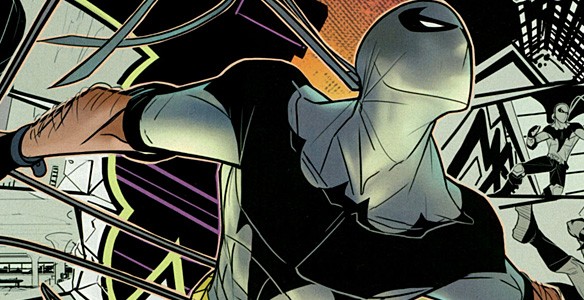
There was a minor eruption in the blogospere recently over a decision by DC Comics to create a spin-off of Batman, to market in France, which would feature a “Muslim Batman.” The storyline goes something like this: Bruce Wayne has decided to franchise his brand around the world, leading to the creation of Batman, Inc. While in France, he finds Bilal Asselah, who is arrested after being caught up in the 2005 immigrant riots while dressed up in spandex and running up walls, and Wayne picks Asselah to be Paris’s coolest new superhero, Nightrunner.

People were upset. Al Arabiyah reports that the outrage within France has been minimal, but blogs around the world are condemning the decision to make France’s Batman a Muslim. Immigrants, you see, “have been rampaging across the country for several years now,” according to one blogger. The “Angy White Dude Blog” was confounded by the idea that a Batman character would ascribe to the “religion of murder.” But the argument that appears to have resonated the most is simply that France should have a French Batman. And apparently, Bilal Asselah isn’t French. Except he was born there.
“Apparently Batman couldn't find any actual Frenchman [sic] to be the ‘French savior,’” complained one blogger. The issue is not simply one of religion, although certainly attitudes towards Islam play a major factor in the blacklash against a Muslim Batman. More acutely, French people (and apparently white people everywhere), don’t want France to be understood as a Maghrebi or non-white nation. There is a fear that the nation that created its national identity, according to Jules Michelet, around the superhero Joan of Arc is at risk of losing that identity to a more popular superhero. Everyone loves Batman, so with the creation of a “French” version, the stakes of identity are high.
 |
| Whose Paris? |
So why are rabid right-wing Americans so concerned with Frenchness? One hears echoes of the birther movement -- even though Barack Obama was born in the United States, his most extremist critics push his perceived foreigness. Maybe they’re concerned about their own othered region to the South -- Mexico. The day of the shooting of Gabrielle Giffords, the New York Times published a story about the abolition of ethnic studies programs in Arizona public schools. (It didn’t get much attention due to the events in Tucson that day.) Because Tucson teacher Curtis Acosta’s class taught students to understood the history of United States imperialism and to explore the contingencies of state borders and national identities, it was understood to be sowing the seeds of division and hatred. Arizona likes its history like the French right likes its Batman: nativistic.
The opposition to the Muslim Batman probably won’t amount to much, but it did lead the creator of Nightrunner, David Hine, to respond to his critics. When asked what he thought about the charge that Bilal is not a Frenchman, he responded: “I’d like to see [the bloggers] in a room full of French Algerians making that point.” But when pressed, he stepped back from the controversy, insisting that he wasn’t trying to make a political statement, only trying to write good comics.
Comics, of course, have always been political, ever since DC published the first Superman story in which the hero battled evil bankers. The early Superman comics were heavy with New Deal politics. Deeper readings would reveal that Superman himself was an immigrant, an intent often ascribed to his creators’ foreignness. Jerry Siegel and Joe Shuster were Jewish immigrants at the head of a long line of Jewish immigrant and first generation American comic book writers, including Will Eisner, Harvey Kurtzman, Jack Kirby and Stan Lee. Their creations, like X-Men, Mad Magazine, and even Captain America, have often questioned or satirized nationalistic or bigoted discourses. But explicit critiques of normative Americanness were off-limits, the writers’ own subjectivities bound by a heavily assimilationist culture.
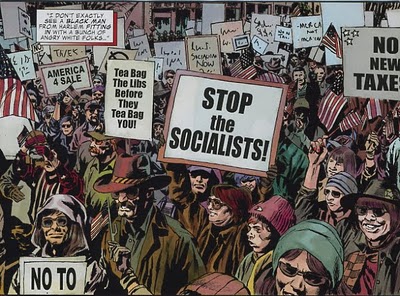 |
| Captain America took on these Tea-Partiers last year. |
So, in imposing strict anti-immigration policies, abolishing ethnic studies, arming white citizens, and deporting anyone who looks funny, Arizona is doing something far worse than creating an atmosphere of fear and hatred, and threatening thousands of people’s material well beings. The state is quite possibly preventing the appearance of the next Harvey Pekar (who passed away recently). And that is unacceptable.

Let’s hope that a Nightrunner movie gets made someday, to show popular audiences the vision of demotic cosmopolitanism that the Jewish-American comic writers fell short of. If all goes well, M. Night Shyamalan will direct, and will cast Jim Carrey in the role of Bilal.
You can find more Nightrunner artwork here: http://trevormc112.deviantart.com/gallery/?offset=0

As I spin my lonely dreydl on this Christmas eve, I wish my goyish friends a happy holiday. I’m a little jealous. But not because I don’t get any presents, but because Christmas music is way cooler than Hannukkah music. The closest we get to popular holiday tunes are an Adam Sandler song and the Klezmatics’ album of Woody Guthrie penned Hannukkah music.
OK, so most contemporary Christmas music sucks. I know -- I worked at a record store for five years, during which we were forced to play Christmas tracks around the clock every December. I knew all the words to Rosie O’Donnell’s A Rosie Christmas the year that one was released. I’ll spare you a hyperlink.

But if Bob Dylan can get into Christmas music, I guess I can too. After all, Darlene Love boasts that it took three Jews to write what she terms the greatest Christmas song of all time:
Darlene returned the favor some years later with “Christmas for the Jews”, an instant rhythm and blues classic if there ever was one.
Here’s Miles Davis on Christmas:
“Blue Xmas” is on a compilation CD called Hipsters’ Holiday, which I recommend, although I have found that evangelical East Texans don’t like it. But they spin Bob Wills tunes in Aggie country, and that’s OK too (Aaah-Aaah!). My next pick probably doesn’t go down very well down there either, but I understand that its quite popular in the UK around Christmastime, where they presumably have a better collective sense of humor:
No knocking Darlene Love, but “Fairytale of New York” might just be the greatest song of all time, Christmas or not. Those three Jews were seriously bested by a couple of Irishmen. I tend to listen to “Fairytale of New York” on repeat whenever I dig it out.
Here’s Miles Davis on Christmas:
“Blue Xmas” is on a compilation CD called Hipsters’ Holiday, which I recommend, although I have found that evangelical East Texans don’t like it. But they spin Bob Wills tunes in Aggie country, and that’s OK too (Aaah-Aaah!). My next pick probably doesn’t go down very well down there either, but I understand that its quite popular in the UK around Christmastime, where they presumably have a better collective sense of humor:
No knocking Darlene Love, but “Fairytale of New York” might just be the greatest song of all time, Christmas or not. Those three Jews were seriously bested by a couple of Irishmen. I tend to listen to “Fairytale of New York” on repeat whenever I dig it out.
Happy Chrismukkahzaa everyone. Sorry about that war on Christmas that we started. Maybe the above illustrates that to a large degree, as a culture we've already moved past narrow definitions of the holiday season, both in terms of those that would privilege a false sort of authenticity that legitimizes hierarchies of moral authority, and those that would place the crass commercialization of the holidays above discourses that poke holes into Christmas mythology, or those that celebrate charity and community. Yes, the radio still plays Mariah Carey way too much. But these are not really obscure or "indie" genres or artists that I've selected either. (Sorry that there are no heavy metal Christmas tunes here, E.)
Now then, about that whole peace thing:
Some say the world will end in fire,
Some say in ice.
From what I've tasted of desire
I hold with those who favor fire.
But if it had to perish twice,
I think I know enough of hate
To say that for destruction ice
Is also great
And would suffice.
--Robert Frost

The Giant Menorah: A New Superweapon in the War on Christmas
Earlier this week, a county snow plow caught fire in the suburban town of Prior Lake. Fortunately, its driver escaped without injury, and nobody else was hurt. No one knows what lit the plow aflame, but a full tank of gas aided in its immolation. According to the local fire chief, “That’s the reason there was a lot of fire.”
Further east, a suburban home in Apple Valley burned down after a troubled woman doused it with gasoline, struck a match, and tried to kill herself with a screwdriver. This news reminded me of Drowning Mona, a movie about people who drive Yugos. The film starred Neve Campbell, whose good looks and snowy forename embodied the aesthetics of a frosty and fiery winter apocalypse.
In my opinion, one of the best recurring moments of fire and ice is the Winter Olympic torch—the flames I mean, not the related ceremonies. I think it’s great to watch televised Nordic ski racing, even if you have to listen to Al Trautwig’s stupid commentary. But since we can’t look forward to that again until 2014, it’s good to have other icy hot distractions.

Torche's Volcanic Album Cover
Snowy volcanos usually do it for me. Right around our first snowfall this winter, I started listening to the band Torche. Because I’m not super hip on the music scene, I sometimes fall a few years and/or decades behind the state of the art. In this case, I was blasting “Snowblind,” the classic Black Sabbath tune, in honor of our forthcoming snow-mageddon. Then I realized Ozzy’s howling was not literally about snow, but about cocaine. Pleased at having unraveled this metaphor, I decided my chops were in shape for something more current. I came across Torche while browsing “top-rated” heavy metal playlists on the iTunes music store; although, technically, I think their genre is something more like sludge rock or stoner metal. Their melodies whirl atop heavy, drop-tuned guitar riffs, but in major keys. And I think this what really elevates them over any other “metal” band I’ve heard; it transforms the doom and gloom into something more ambiguous and interesting.
Yesterday evening, we endured the winter solstice and crossed into Rumple Minze season. If there’s ever a beverage that represents fire and ice, it’s the oddly-fascist 100-proof peppermint schnapps. Rumple Minze is to your esophagus as Gold Bond is to your dermis. The frozen menthol burn pairs well with hot chocolate, offering a sultry taste redolent of a tryst between the Swiss Miss and Princess Teegra. Another good winter cocktail is the “Grolar Bear” (Ursus horribilus maritimus), a beige blend of peppermint schnapps and bourbon.
In the spirit of the season, let's raise our glasses to the heroes and champions, artists and adventures, lovers, brothers, sisters, and Others that make the world hot and cold. Cheers, and happy holidays!

On Saturday, a bill to repeal the Don’t Ask Don’t Tell policy of the United States’ armed forces was passed by the Senate, and now has no visible hurdles before becoming law. While the repeal of DADT is a good thing, I think it might be a good time to take a step back here, and raise a couple of issues.
First, although this means that servicemen and women who identify as gay or bisexual can serve without being afraid getting fired, it doesn’t mean that life in the military will be any easier. The barbeques on base are not immediately going to start resembling Lady Gaga concerts because, I imagine, most of those who are affected by this bill are likely to keep their sexuality under wraps. Homophobia is not going to disappear from the military overnight.

Second, we should think about the repeal of Don’t Ask Don’t Tell in the context of broader changes in understandings of civil rights in the United States, changes that are often precipitated by the military, or because of American militaristic aims. Ever since the black seaman Dorie Miller, a mess hall cook, manned anti-aircraft guns at Pearl Harbor, leaders have capitalized upon the eagerness of Americans to sacrifice for a country that has systematically discriminated against them.
During World War II, the military paraded Miller and other African Americans around so as to promote a unified citizenry and dissuade racial conflict. Documentary films like The Negro Soldier, the result of collaborations between the Signal Corps, the Office of War Information, and Hollywood, projected an image of a multicultural fighting force, even as troops were still segregated and minorities were given the worst, menial jobs. And features such as Hollywood Canteen dramatized the co-mingling of black, Asian, and Native American soldiers, even as the real Hollywood Canteen, a club in Los Angeles that Bette Davis created for servicemen on shore leave, was under investigation by the FBI because Davis refused to segregate its visitors.
In American government policy, political discourse, and mass culture, civil rights became entangled with ideas about service to the nation. Prisoners at Manzanar and other Japanese-American concentration camps (the U.S. government’s preferred terminology at the time) were only allowed to leave the camp if they swore allegiance to the country that had locked them up, and if they voluntarily enlisted to join the front lines in Europe. Thus thousands of Japanese and other minority soldiers died, with the understanding that their sacrifice was a means to prove their Americaness.
The cold war provoked leaders like Truman, Eisenhower and Kennedy to think about civil rights almost solely in terms of the strategies of a global war. Communists, not only in the Soviet Union, but also those who were dedicated to the struggles of third world liberation movements around the world, pointed to racism and segregation as proof of the hypocrisy of Western democracy. When Truman desegregated the military, he did it to ensure the survival of American hegemony.
For much of the following decade, Hollywood movies spoke in terms of race almost exclusively within the context of military service. And none of them questioned the inanity of making minorities prove their devotion, at the cost of their own blood, to a country that still withheld equal rights. The policy of “Double Victory” that animated African American troops to volunteer in the war against fascism had backfired; The assumption that the subjugated would find equality after proving their loyalty in World War II became a perpetual call for minorities to voice their grievances within the bounds of the conservative nationalism of the early cold war.
As Melani McAlister has argued, the notion of a multi-cultural, egalitarian America has a greater currency in global politics now more than ever. When Barack Obama was elected president, he projected an internationalist image to his Muslim audience in a speech in Egypt for which he was awarded the Nobel Peace Prize, even as he continued to wage two wars in the region. I would argue that his ability to act as a black leader is terribly circumscribed by the necessity that he operate as an American one, but its only the latter that allows for the former.
It is unlikely that terrorists are passing out pamphlets in Pakistan that attack Don’t Ask Don’t Tell. But we might ask why this reform, that which allows gay men and women to die for their country, is being passed while there are still no laws that prevent employers from firing people for being gay, lesbian, bi-sexual or transgendered. Why is it that gay Americans can elect to protect their country, but the same country has elected not to protect them? Some, not all, gay men and women have voiced their opposition to Don’t Ask Don’t Tell in terms of patriotic sacrifice -- I just want to serve my country in a time of war. I don’t mean to entirely dismiss such language as a means to argue for equal rights. And certainly, jobs currently held by homosexuals in the military are diverse enough that it is unlikely that we will see masses of recently outed servicemen sent to the front lines to die in as overwhelming numbers as was suffered by the Japanese-American 442nd Infantry and other minority regiments in wars past. But I wonder if there is a disconnect between this movement and the broader struggle towards social justice, in the United States and abroad.

The 442nd
Does this mean, in repealing Don’t Ask Don’t Tell, that we are elevating an argument for equality that carries with it stipulations that reify militaristic nationalist sentiment and thus validate American global hegemony? Will the movement against Don’t Ask Don’t Tell backfire? I hope not, and I don’t want to overstress the historical parallels here.
In the essay “American Things,” Tony Kushner wrote that gay rights is the same as civil rights, the same as socialism. He championed the concept of America while dismissing the “fixed fetishes of democracy and freedom” and chastising those who saw the American experiment as a finished project, and American democracy as an excuse to tyrannize minorities.
“The only politics that can survive an encounter with this world,” he says, “is a politics that can encompass both the harmonics and the dissonance. The frazzle, the rubbed raw, the unresolved, the fragile and the fiery and the dangerous: These are American things.”
To be honest, I don’t really know what all of that means. But it strikes me as Bulosan-esque, and maybe it is along the lines of what’s missing in the discussion of Don’t Ask Don’t Tell.
First, although this means that servicemen and women who identify as gay or bisexual can serve without being afraid getting fired, it doesn’t mean that life in the military will be any easier. The barbeques on base are not immediately going to start resembling Lady Gaga concerts because, I imagine, most of those who are affected by this bill are likely to keep their sexuality under wraps. Homophobia is not going to disappear from the military overnight.
Second, we should think about the repeal of Don’t Ask Don’t Tell in the context of broader changes in understandings of civil rights in the United States, changes that are often precipitated by the military, or because of American militaristic aims. Ever since the black seaman Dorie Miller, a mess hall cook, manned anti-aircraft guns at Pearl Harbor, leaders have capitalized upon the eagerness of Americans to sacrifice for a country that has systematically discriminated against them.
During World War II, the military paraded Miller and other African Americans around so as to promote a unified citizenry and dissuade racial conflict. Documentary films like The Negro Soldier, the result of collaborations between the Signal Corps, the Office of War Information, and Hollywood, projected an image of a multicultural fighting force, even as troops were still segregated and minorities were given the worst, menial jobs. And features such as Hollywood Canteen dramatized the co-mingling of black, Asian, and Native American soldiers, even as the real Hollywood Canteen, a club in Los Angeles that Bette Davis created for servicemen on shore leave, was under investigation by the FBI because Davis refused to segregate its visitors.
In American government policy, political discourse, and mass culture, civil rights became entangled with ideas about service to the nation. Prisoners at Manzanar and other Japanese-American concentration camps (the U.S. government’s preferred terminology at the time) were only allowed to leave the camp if they swore allegiance to the country that had locked them up, and if they voluntarily enlisted to join the front lines in Europe. Thus thousands of Japanese and other minority soldiers died, with the understanding that their sacrifice was a means to prove their Americaness.
The cold war provoked leaders like Truman, Eisenhower and Kennedy to think about civil rights almost solely in terms of the strategies of a global war. Communists, not only in the Soviet Union, but also those who were dedicated to the struggles of third world liberation movements around the world, pointed to racism and segregation as proof of the hypocrisy of Western democracy. When Truman desegregated the military, he did it to ensure the survival of American hegemony.
For much of the following decade, Hollywood movies spoke in terms of race almost exclusively within the context of military service. And none of them questioned the inanity of making minorities prove their devotion, at the cost of their own blood, to a country that still withheld equal rights. The policy of “Double Victory” that animated African American troops to volunteer in the war against fascism had backfired; The assumption that the subjugated would find equality after proving their loyalty in World War II became a perpetual call for minorities to voice their grievances within the bounds of the conservative nationalism of the early cold war.
As Melani McAlister has argued, the notion of a multi-cultural, egalitarian America has a greater currency in global politics now more than ever. When Barack Obama was elected president, he projected an internationalist image to his Muslim audience in a speech in Egypt for which he was awarded the Nobel Peace Prize, even as he continued to wage two wars in the region. I would argue that his ability to act as a black leader is terribly circumscribed by the necessity that he operate as an American one, but its only the latter that allows for the former.
It is unlikely that terrorists are passing out pamphlets in Pakistan that attack Don’t Ask Don’t Tell. But we might ask why this reform, that which allows gay men and women to die for their country, is being passed while there are still no laws that prevent employers from firing people for being gay, lesbian, bi-sexual or transgendered. Why is it that gay Americans can elect to protect their country, but the same country has elected not to protect them? Some, not all, gay men and women have voiced their opposition to Don’t Ask Don’t Tell in terms of patriotic sacrifice -- I just want to serve my country in a time of war. I don’t mean to entirely dismiss such language as a means to argue for equal rights. And certainly, jobs currently held by homosexuals in the military are diverse enough that it is unlikely that we will see masses of recently outed servicemen sent to the front lines to die in as overwhelming numbers as was suffered by the Japanese-American 442nd Infantry and other minority regiments in wars past. But I wonder if there is a disconnect between this movement and the broader struggle towards social justice, in the United States and abroad.
The 442nd
Does this mean, in repealing Don’t Ask Don’t Tell, that we are elevating an argument for equality that carries with it stipulations that reify militaristic nationalist sentiment and thus validate American global hegemony? Will the movement against Don’t Ask Don’t Tell backfire? I hope not, and I don’t want to overstress the historical parallels here.
In the essay “American Things,” Tony Kushner wrote that gay rights is the same as civil rights, the same as socialism. He championed the concept of America while dismissing the “fixed fetishes of democracy and freedom” and chastising those who saw the American experiment as a finished project, and American democracy as an excuse to tyrannize minorities.
“The only politics that can survive an encounter with this world,” he says, “is a politics that can encompass both the harmonics and the dissonance. The frazzle, the rubbed raw, the unresolved, the fragile and the fiery and the dangerous: These are American things.”
To be honest, I don’t really know what all of that means. But it strikes me as Bulosan-esque, and maybe it is along the lines of what’s missing in the discussion of Don’t Ask Don’t Tell.

 Posts
Posts


